

Stemming from my passions towards theoretical physics since my undergraduate days, my research interests have been mostly focussed on cosmology, gravity, early universe, galactic dynamics and dark matter. Broadly I like to work on a field where there is a healthy combination of theory, observational data and statistical modelling.
Doctoral research: power-spectrum analysis of early-type galaxies
For my PhD thesis I worked on a project on quantifying the distribution of dark matter in massive elliptical galaxies using strong gravitational lensing at Leon Koopman’s group. I developed a statistical methodology to measure the mass power-spectrum of early type lens galaxies in the 1-10 kpc scales. In collaboration with the other members of the research group, we also applied the theory to Hubble Space Telescope (HST) imaging of the galaxy-galaxy strong gravitational lens system SDSS J0252+0039 and gave observational constraints on the sub-galactic matter-power spectrum. Below I show the lens and it’s surface brightness modeling:
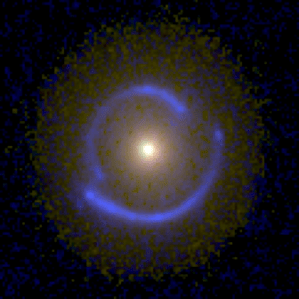

We looked at the residuals and had done power spectrum analysis to statistically infer the fluctuations in the lens potential which might arise from the low mass substructures (for details of this work, look Dorota et al, arXiv:1803.05952). We also compared different galaxy formation scenarios using the state-of-the-art N-body hydrodynamic simulation Evolution and Assembly of GaLaxies and their Environments (EAGLE). In order to perform such comparative analysis, we applied the power-spectrum formalism to the simulated galaxies to gain insights about the sub-grid physics behind the galaxy formation and evolution.

Application of AI in strong-lensing:
Since 2015, I have also been involved in a project of applying artificial intelligence in the fields of astronomy. We used Convolutional Neural Network (CNN) to find the strong-lens galaxies in Kilo Degree Survey (KiDS). This work was also highlighted by a press release. My contribution in this work (and the follow up papers) was mostly in simulating the training set for the CNN, consisting of a large number of realistic lens-galaxies — some examples are given below:

Below I show few RGB images out of the 56 candidates down-selected through a visual inspection of the 761 CNN candidates:





Post-doctoral research:
Currently, as part of my post-doctoral research at Target Field Lab, I am primarily working on data mining and data validation — with a special emphasis on text mining and Natural Language Processing (NLP) using Deep Learning networks, such as hierarchical attention networks, BERT Question-Answering system etc.
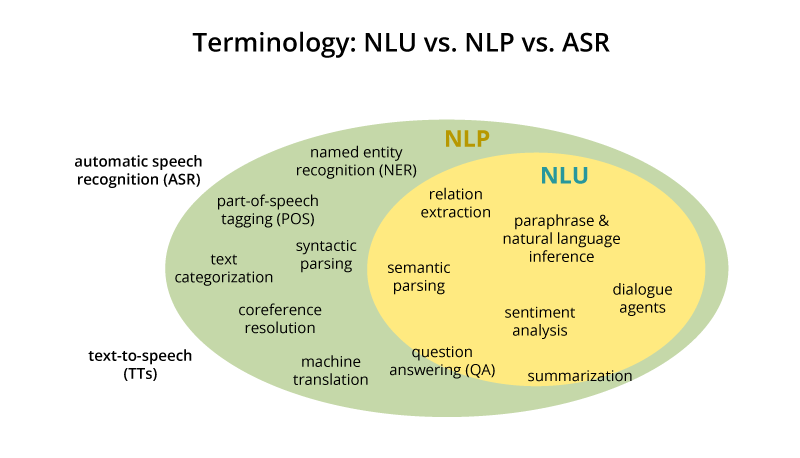
Source: https://nlp.stanford.edu/~wcmac/papers/20140716-UNLU.pdf
Master thesis and undergraduate research:
My Masters and Bachelor research thesis are titled briefly below:
- Weak gravitational lensing of Cosmic Microwave Background Radiation (CMBR) by Gravitational Waves and Large Scale Structures (Masters Project): under guidance of Prof. Somak Raychaudhury, Presidency University, Calcutta, in collaboration with Prof. Tarun Souradeep of Inter University Centre for Astronomy and Astrophysics (IUCAA), Pune, India.
- Frame Drag Vortexes and Tidal Tendexes in Spacetime Curvature (undergraduate research thesis as part of the Visiting Students’ Program at IUCAA, Pune, India): under guidance of Prof. Tarun Souradeep.
During my Masters I was also involved in two short projects on Gravitational Waves Data Analysis and Numerical Relativity (Unuqual-mass precessing binary black-hole simulations).

Websites and links:
 https://orcid.org/0000-0002-8682-1533
 Saikat Chatterjee