

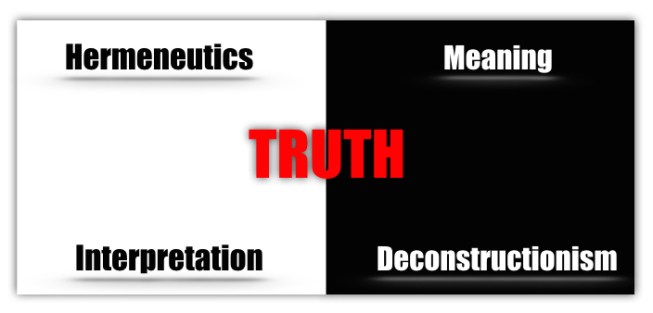
What is Truth? Do authority, government, media create and sell truth to us? Historians for example may ask: did Saddam Hussein really have mass destructive weapons that U.S. went to war with Iraq in 2003? Conspiracy theorists may come with numerous supporting evidences that Illuminati is real. Or one might ask whether moon landing was faked? So, what are the actual facts that we can rely upon to retrieve the truth in this post-truth planet, in the age of information? In fact:
“every matter of fact is a matter of interpretation that picks out the facts” [1].
Here comes Hermeneutics or theory of interpretation. In the context of postmodernism, the meaning of meaning has been deconstructed, pure objectivity or eternal truth has taken a diverse, pluralistic, relative form. Anyone today sitting at almost any corner of the world exchanges information through digital platforms; although justification of the “truthness” of that information has become more questionable. Individual’s identities have been digitalized. In the era of social media shout-outs, everyone is being served by the glorious opportunities to become a YouTube star overnight maybe by representing the art of butchering or to become a spiritual Guru by revealing the meaning of life to the truth-seekers of a capitalistic world or to turn into a makeup artist by showing off the skills of loving and decorating oneself.
So, what is Truth and it’s meaning for an information overloaded citizen of earth? A postmodernist (generally known as liberal [3]) will say: if truth has been interpretative, if truth is a process, if it has been constructed; it must be de-constructable and again re-constructable. This gives fresh breathing air to any democratic system, the protection against authoritative and dogmatic truths in all practices of our society, starting from politics to art, to science [1].
So, how one can actually de-bias and deconstruct the interpretations and can get a better taste of the facts? Via Reasoning? Empirical evidences? In fact no journey of human understanding; be it investigating it’s own ontological anxiety or the laws of nature, can be done alone just by dry logic or by observational findings. If one believes that rational thinking alone can explain the dynamics of human behavior, society and politics, Baggini says: [2]
“Armed with evidence from psychology that most of our thinking is done automatically and quickly by ‘hot’ emotion-laden processes, rather than consciously & slowly by the cool intellect…. Humans, on this view are not rational but rationalisers, not acting on good reasons but finding reasons retrospectively.”
So, in the light of our present understanding of cognitive studies, the origin of most of our passions are semi-rational, semi-certain, spontaneous, probabilistic; just like existence of life in this universe without any inherent purpose, which (according to our paradigm of contemporary cosmology) emerged from primordial quantum fluctuations of universe via gravitational instability. But, in our minds (in other words, in the machinery of our intelligence), we can rationalize, strategize, simulate the possible future realities and reflect our ‘will’ to execute & direct those passions in a relatively rational way. This leaves us with the freedom to create our meaning(s) of life.
What makes this whole game of life most interesting is, Qualia or acquired subjective characteristics which emerge from phenomenal experiences (aka hard problem of consciousness). This can not be communicated between individual beings with it’s completeness through any form of language other than direct subjective experience. Degree of truth about the universe to an individual thus depends on the accessibility relations and interpretations of the information which necessarily has led the world citizens to live in an age of relative truth(s).
Semiotically speaking, this is an inescapable, ineradicable war every postmodern truth-seeker is constantly fighting to de-bias the cognitive interpretational biases of the signifiers to know epistemologically the signified more objectively; which naturally leads to the emergence of plurality or ‘multi’ nature of truth. Anyways, apart from the interpretation of the reader, bias is intentionally or unintentionally always imposed in the signifiers itself by the author. For example, text has been used over the time of history to express half-truth, for manipulative, authoritative purposes. In the context of historical texts and politically intentional bias, Orwell’s words are quite significant here [4]:
“Political language – and with variations this is true of all political parties, from Conservatives to Anarchists – is designed to make lies sound truthful and murder respectable , and to give an appearance of solidity to pure wind.
No book is free from political bias”
So, path of truth is fuzzy, continuous, it lies in an unending interplay between the so called binary opposites; e.g. idealism vs pragmatism, reasoning vs revelation and so on. In Hegelian dialectics, the antagonism of these oppositions (thesis and antithesis) collapse into a synthesis but Derrida showed through his essays on deconstructionism that the binary oppositions can’t be resolved into a synthesis; being completely free from the contradiction. The objective of deconstructing the text is not to get rid of these oppositions; as they are necessary to the structure of the text to make meaning but, the goal of this play is to re-interpret and re-establish the violent hierarchy of the dual oppositions intrinsic to the text, armed with postmodern hermeneutics.
Thus, we see that the words don’t carry any absolute meaning by itself and in fact, meaning is never present. It’s always deferred to other words and signs (signifiers). So, meaning comes from différance: synchrony with other words at a specific moment of time (the statics of the langauge) and diachrony: the historical development, evolution and definition of the word (the dynamics of the language). In this way Derrida declares the death of the author through his famous assertion “there is no outside-text”.
So, what are the cons in this multicultural, de-centred, pluralistic, democratic, postmodern world of relative truths and subjective interpretations? Well, “there are as many truths as there are opinions” [1] and some answers to the same question can be in utter conflict with each other. But I personally tend to believe that this is the inevitable price postmodernists have to pay if they care to maintain the liberal perspective towards truth. And just like a deconstructionist’s violent unending analysis of text, truth will remain an ongoing war against manipulative, persuading, authoritative, creative opinions that surround our lives, be it governmental, political, societal or at a very personal level; coming from our next door neighbor.
REFERENCES:
-
- John D. Caputo (2018), Hermeneutics: Facts and Interpretations in the Age of Information. Penguin Books
- Julian Baggini (2017), A short history of truth: Consolations for a post-truth world. Quercus Editions.
- Terry Eagleton (2008), The Meaning of Life: A very short introduction. Oxford University Press
- George Orwell (2017), Orwell on truth. Penguin Books
Disclaimer: This is a personal weblog and it’s not a peer-reviewed article, rather more of an opinion piece in the light of reviewing the books referred. Which means that the ideas and thoughts expressed in the form of literary criticism are entirely from my perspective and I have the sole responsibility for the content and they are not intended to harm or disrespect any particular authority or any individual.

 Saikat Chatterjee